How Rinne turns a provider’s rejection or request for more into structured reasons and requirements, and how the next attempt asks only for what the provider refused or added.
A provider can answer with something a person has to read: a rejection, or a request for more documents or information on an affiliation it is still analyzing. Rinne reads that answer, translates it into Rinne’s vocabulary, and updates the merchant’s requirements. You get structured reasons and a precise list of what to send, and nothing that is still valid is ever asked again.
A rejection moves the affiliation to REJECTED at once. provider_status_message carries the provider’s own text, and rejection_reasons stays empty until Rinne’s review.
A request for more on an affiliation the provider is still analyzing leaves the status where it is until the review lands. provider_status_message carries what the provider said.
Rinne reads the provider’s text and records what it means, aiming to finish the same business day:
Which documents or verifications were refused. They become REJECTED for that provider and are never sent to it again, and their requirements read REJECTED until new evidence arrives.
Which requirements the provider added for this merchant: documents, an INFORMATION question, or an EVIDENCE_PACKAGE request. Each carries a description written for the merchant’s contact.
Which merchant data has to be corrected, or that the refusal is final.
affiliation.requirements-changed fires with the IDs of the requirements that changed. On a rejection, the affiliation also gets rejection_reasons and rejection_reviewed_at:
Affiliation after the review
{ "id": "2352ebe5-97c2-4625-8535-cc21b732787a", "provider": "CELCOIN", "status": "REJECTED", "provider_status_code": "reproved", "provider_status_message": "Documento do sócio ilegível", "rejection_reviewed_at": "2026-10-03T16:40:00.000Z", "rejection_reasons": [ { "code": "DOCUMENT_UNREADABLE", "message": "The contact's identity document could not be read. Send a new, sharp photo of the front and the back.", "action": "RESUBMIT_DOCUMENT", "requirement_id": null, "onboarding_document_id": "161e2065-1179-4484-9ea3-faf62199595e" } ], "onboarding_url": null}
A review that finds nothing for the merchant to do sets rejection_reviewed_at with an empty rejection_reasons.
Send new evidence for the document named in onboarding_document_id (or the requirement in requirement_id). The refused one no longer counts at this provider
NEW_REQUIREMENT
Satisfy the requirement named in requirement_id, which the review added
FIX_COMPANY_DATA
Correct the merchant with PATCH /v1/merchants/{merchantId} (or PATCH /v1/companies/me for your organization), then create the affiliation again
NONE
Final: there is nothing to resend, and a new affiliation would be refused again. message says why
Supply the new items through the API or the onboarding link. What happens next depends on what the provider answered:
A rejection: a new affiliation
A request for more: the same affiliation continues
A REJECTED affiliation never goes back to collecting at any provider; it leaves REJECTED only if the provider reverses its refusal. So every correction after a rejection is a new submission. Create a new affiliation for the same provider: it starts from the merchant’s updated requirements, with everything still valid already SATISFIED, such as an approved biometric verification and the documents the provider did not refuse. If something is pending it comes with its own onboarding link; a rejected affiliation has none.
In the example above, the new affiliation asks only for a new identity document. When it arrives, Rinne submits.
Only CAPPTA asks for more on an affiliation it is still analyzing, and it takes the supplement on that same affiliation. After the review the affiliation is WAITING_DOCUMENTS and its onboarding_url carries a link for the new items. This wait has no deadline: the affiliation stays there until the items arrive or you cancel it. Once the last one is satisfied, Rinne delivers the supplement and the affiliation moves to PENDING, then back to PROCESSING. See the example below, through the link and through the API.
Created a new affiliation before the review of the previous rejection landed? It is created PENDING and held. When the review lands it moves to WAITING_DOCUMENTS if something was reset or added, or is submitted at once.
Example: a provider asks for proof of the business
A typical request on an open CAPPTA affiliation asks how the merchant earns its revenue and for proof that the business operates. After Rinne’s review the merchant has two new requirements, both with originPROVIDER_REQUEST: an INFORMATION question and an EVIDENCE_PACKAGE, each with a description written for the contact. affiliation.requirements-changed names them, and the affiliation is WAITING_DOCUMENTS. Either path below satisfies them; what one supplies disappears from the other.
Through the onboarding link
Through the API
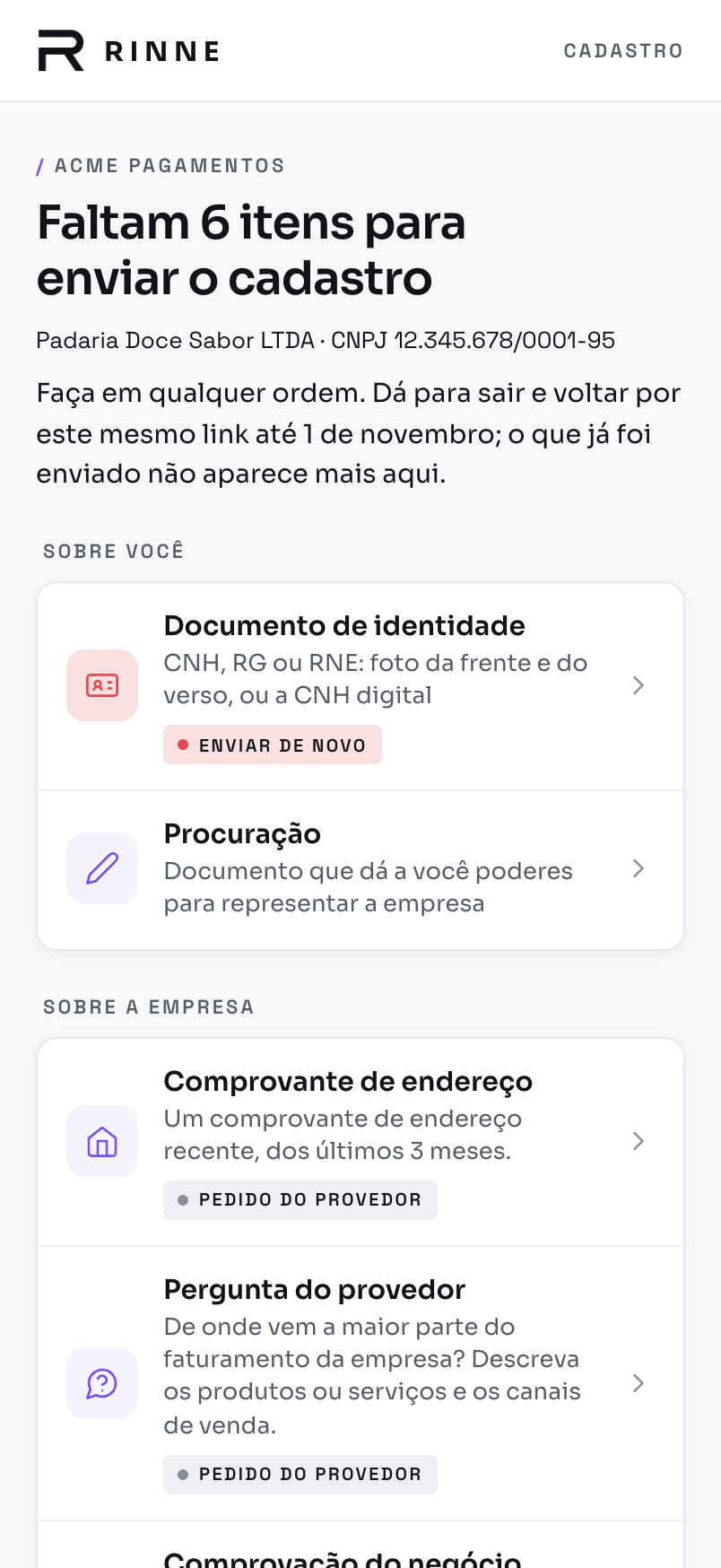
Send the contact the affiliation’s onboarding_url. The new items appear tagged “Pedido do provedor”, each in the provider’s words, beside anything a refusal sent back:
The new requests
A text answer
Files and a note
The proof closes when the contact sends it: no more files can be added unless the provider asks again.
{ "data": [ { "id": "c789cd1d-5b85-4a01-af0c-02ce13c47926", "company_id": "a7089150-0d61-498f-b7ca-4767e4e4d6a4", "provider": "CAPPTA", "type": "INFORMATION", "subject_document_number": "12345678000195", "subject_role": "COMPANY", "origin": "PROVIDER_REQUEST", "description": "Where does most of the company's revenue come from? Describe the products or services and the sales channels.", "status": "PENDING", "accepted_document_types": null, "satisfied_by": null, "waived_at": null, "created_at": "2026-10-14T15:20:00.000Z", "updated_at": "2026-10-14T15:20:00.000Z" }, { "id": "56540bc6-946c-4089-a873-2e6bf823766b", "company_id": "a7089150-0d61-498f-b7ca-4767e4e4d6a4", "provider": "CAPPTA", "type": "EVIDENCE_PACKAGE", "subject_document_number": "12345678000195", "subject_role": "COMPANY", "origin": "PROVIDER_REQUEST", "description": "Show that the business exists and operates: photos of the storefront and interior, a website, social profiles or recent invoices.", "status": "PENDING", "accepted_document_types": null, "satisfied_by": null, "waived_at": null, "created_at": "2026-10-14T15:20:00.000Z", "updated_at": "2026-10-14T15:20:00.000Z" } ]}
2
Answer the question
cURL
curl -X POST https://api-sandbox.rinne.com.br/core/v1/merchants/a7089150-0d61-498f-b7ca-4767e4e4d6a4/onboarding-requirements/c789cd1d-5b85-4a01-af0c-02ce13c47926/answer \
  -H "x-api-key: YOUR_API_KEY" \
  -H "Content-Type: application/json" \
  -d '{
    "text": "Most of it comes from bread and pastries sold at the counter of the physical store. We also take orders by message for pickup."
  }'
The response is 201 with the question SATISFIED and the text in satisfied_by.answer.
3
Attach the files to the package
Open one upload per file with typeOTHER and the package’s ID in requirement_id, then send the bytes and confirm it, as in Upload documents:
Repeat for each file, here also interior.jpg. Until the package is closed, its requirement stays PENDING however many files it holds.
4
Close the package with its explanation
cURL
curl -X POST https://api-sandbox.rinne.com.br/core/v1/merchants/a7089150-0d61-498f-b7ca-4767e4e4d6a4/onboarding-requirements/56540bc6-946c-4089-a873-2e6bf823766b/answer \
  -H "x-api-key: YOUR_API_KEY" \
  -H "Content-Type: application/json" \
  -d '{
    "text": "The bakery has operated at the registered address since 2019. Attached: the storefront and the counter during opening hours."
  }'
201 Created
{ "id": "56540bc6-946c-4089-a873-2e6bf823766b", "company_id": "a7089150-0d61-498f-b7ca-4767e4e4d6a4", "provider": "CAPPTA", "type": "EVIDENCE_PACKAGE", "subject_document_number": "12345678000195", "subject_role": "COMPANY", "origin": "PROVIDER_REQUEST", "description": "Show that the business exists and operates: photos of the storefront and interior, a website, social profiles or recent invoices.", "status": "SATISFIED", "accepted_document_types": null, "satisfied_by": { "onboarding_document_ids": [ "ab1f2e55-3588-4c33-841a-e152f770e8a8", "58ddade2-39c6-47ca-873e-b9ba8ff1ff54" ], "biometric_verification_id": null, "answer": "The bakery has operated at the registered address since 2019. Attached: the storefront and the counter during opening hours." }, "waived_at": null, "created_at": "2026-10-14T15:20:00.000Z", "updated_at": "2026-10-14T16:42:31.000Z"}
The text is optional, but a package with neither text nor an accepted attachment answers 400. Once closed, a new attachment answers 409 until the provider refuses the package.
With both requirements SATISFIED, Rinne delivers the supplement: the affiliation moves to PENDING, then back to PROCESSING while the provider analyzes it.
When the provider reverses a rejection at Rinne’s request, the same affiliation goes from REJECTED to ACTIVE, and affiliation.status-changed reports it.
Merchant data was corrected
After FIX_COMPANY_DATA, correcting a merchant also runs its KYC checks again, as any update of its identification data does. Then create the new affiliation.
A final refusal
Rinne does not block a new affiliation after actionNONE, but the provider refuses it again. Treat NONE as the end of onboarding with that provider for this merchant.
A document refused by one provider
The refusal is per provider. The document is never sent to the provider that refused it again, while every other provider keeps using it.
Assistant
Responses are generated using AI and may contain mistakes.